Most requested for
Cricket practice and play zones
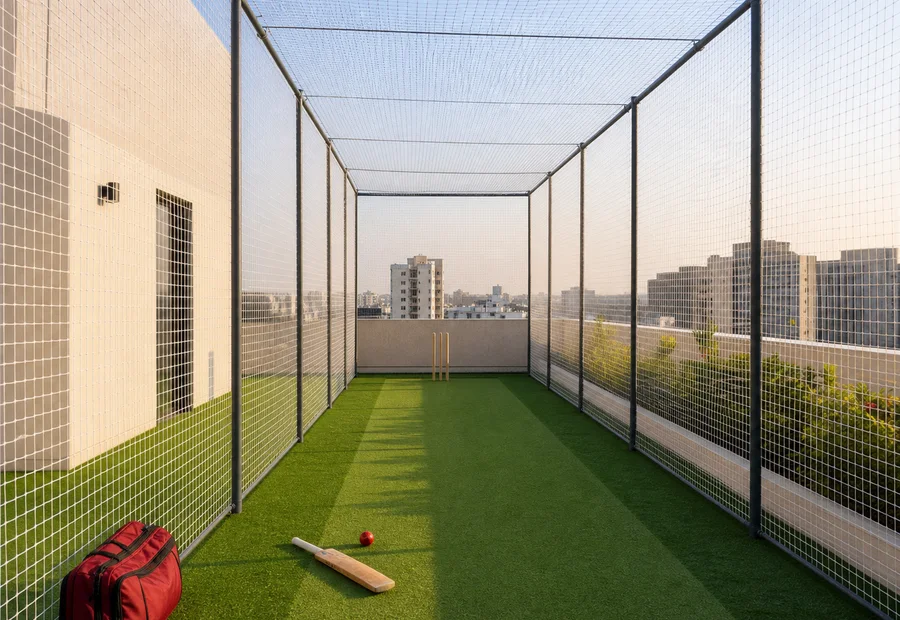
Sports netting is commonly requested for terrace cricket, apartment play areas, school practice lanes, and compact activity spaces.
Practice and play-area netting
Sports nets help convert terraces, apartment play zones, schools, clubs, and small open spaces into controlled practice areas. The right setup depends on the sport, ball speed, available height, anchor strength, surrounding walls, and how often the space will be used.
Planned for cricket practice, terrace play, box cricket, football, schools, clubs, and apartment activity zones
Designed around ball impact, side coverage, roof height, support poles, wind, and safe entry points
Most requested for
Sports netting is commonly requested for terrace cricket, apartment play areas, school practice lanes, and compact activity spaces.
Preferred material
The net should be selected by sport, ball speed, mesh size, outdoor exposure, and whether it needs a frame or only edge fixing.
Base location
Nagamma Safety Nets serves Bangalore from Marathahalli, with site planning across apartments, schools, villas, and commercial activity areas.
Site fit
Sports Nets work looks simple from far away, but the lasting result depends on small site details. The right work starts by reading the balcony, window, or utility opening before choosing a fitting method.
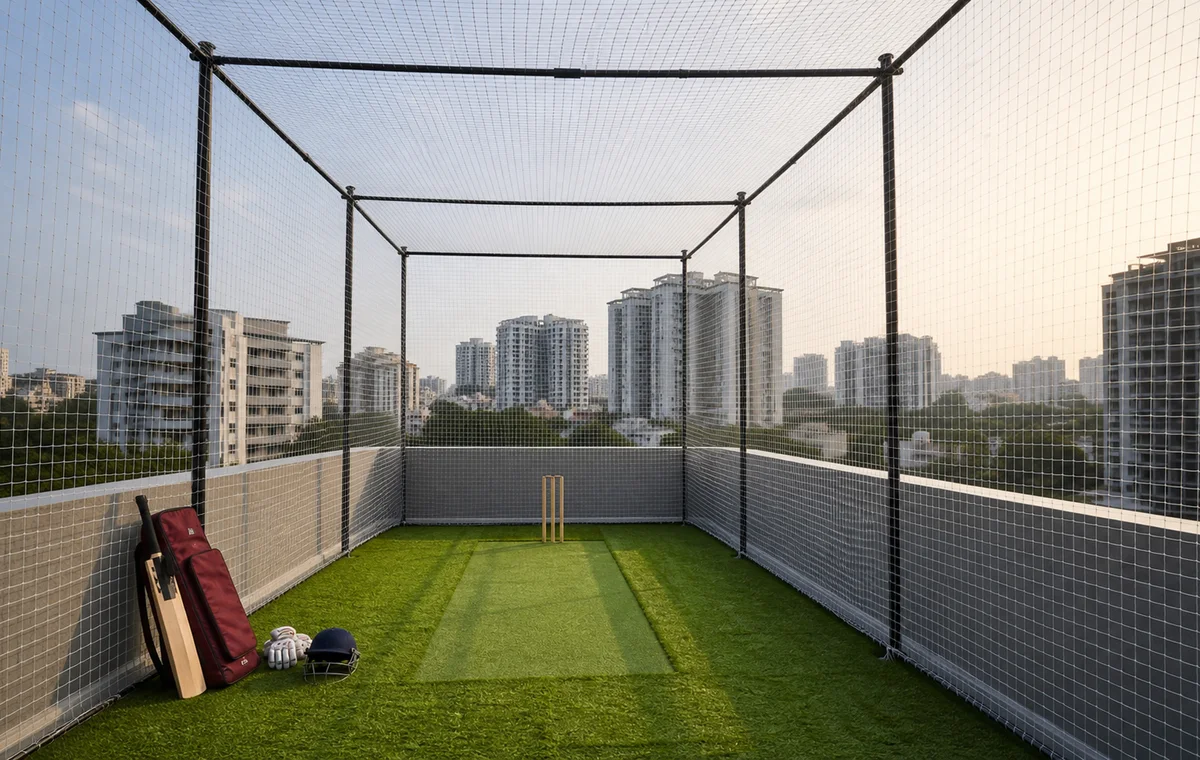
A terrace practice setup should stop balls from leaving the space from the sides and top. The net layout should account for parapet height, neighbouring balconies, water tanks, and safe access.
In apartment communities, sports nets help reduce ball movement toward parking, glass, gardens, walkways, and nearby homes. The aim is safer play without making the space feel closed.
A school or coaching lane gets regular ball impact and rougher daily use. The net, border rope, hooks, and frame support should be chosen for repeated practice, not occasional home play.
Bangalore terraces and open grounds can catch strong wind. Larger sports nets need support lines, poles, or frame planning so the net does not sag, flap, or pull anchors loose.
Installation views
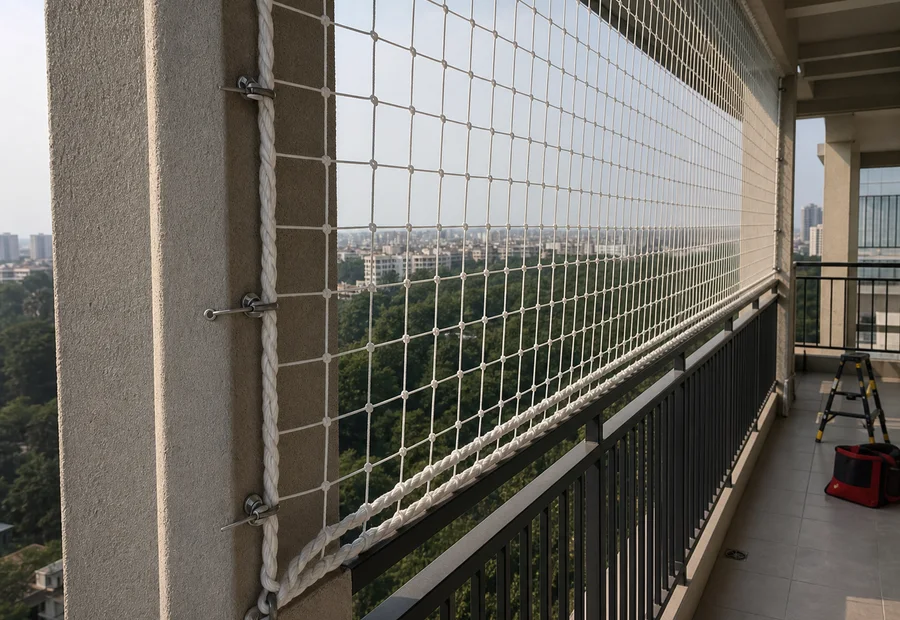
These views show the kind of balcony faces, window openings, and utility areas that need measured installation instead of a quick one-size-fits-all setup.
Materials
The net is only one part of the job. A reliable installation also needs the correct mesh size, edge support, fixing points, and a finish that works with the balcony surface.
| Part | Ask this | Good choice | Why it matters |
|---|---|---|---|
| Net material | Is the net suitable for the sport and ball impact? | Nylon or HDPE sports net selected by sport, ball speed, and exposure | A light balcony net will not perform like a practice net when hit repeatedly by cricket or football shots. |
| Mesh size | Will the mesh stop the ball used in this activity? | Smaller mesh for cricket balls, larger only where the sport allows it | Wrong mesh size can allow smaller balls through or make the net heavier than needed. |
| Border rope | How will the edges be strengthened and tightened? | Reinforced border rope or cable support along the net boundary | Most sports-net stress collects at the top and side edges during repeated impact. |
| Support frame or poles | Does the site need poles, frame support, or only wall fixing? | Frame, pole, or anchor layout decided after measuring the span | Large openings and terrace setups usually need more than simple hooks to stay neat. |
| Access and entry | How will people enter, retrieve balls, and clean the area? | Planned entry flap, movable side, or service access where needed | A net that blocks daily movement becomes irritating even if it stops the ball well. |
Ask this
Is the net suitable for the sport and ball impact?
Good choice
Nylon or HDPE sports net selected by sport, ball speed, and exposure
Why it matters
A light balcony net will not perform like a practice net when hit repeatedly by cricket or football shots.
Ask this
Will the mesh stop the ball used in this activity?
Good choice
Smaller mesh for cricket balls, larger only where the sport allows it
Why it matters
Wrong mesh size can allow smaller balls through or make the net heavier than needed.
Ask this
How will the edges be strengthened and tightened?
Good choice
Reinforced border rope or cable support along the net boundary
Why it matters
Most sports-net stress collects at the top and side edges during repeated impact.
Ask this
Does the site need poles, frame support, or only wall fixing?
Good choice
Frame, pole, or anchor layout decided after measuring the span
Why it matters
Large openings and terrace setups usually need more than simple hooks to stay neat.
Ask this
How will people enter, retrieve balls, and clean the area?
Good choice
Planned entry flap, movable side, or service access where needed
Why it matters
A net that blocks daily movement becomes irritating even if it stops the ball well.
Compare
Sports Nets can be the right answer for many homes, but it is not the right answer for every balcony or window problem. This comparison keeps the decision honest.
| Option | Best for | Strength | Limitation | Choose when |
|---|---|---|---|---|
| Sports nets | Cricket, football, badminton, school practice, terrace play, and apartment activity spaces | Controls ball movement and protects nearby people, glass, vehicles, and open edges | Needs correct mesh and support planning for each sport | The main need is controlled practice or play without balls leaving the activity area. |
| Cricket practice net | Batting lanes, bowling practice, coaching, and terrace cricket | Focused impact control for cricket balls and repeated practice | May need stronger side and roof coverage than general sports netting | Cricket is the primary activity and ball speed is the main concern. |
| General safety net | Open edges, fall-prevention style protection, or broad area coverage | Useful for many safety applications around homes or buildings | Not always built for repeated sports impact | The space needs edge safety more than dedicated sports practice. |
| Metal fencing | Permanent outdoor grounds and visible boundary control | Rigid and durable for fixed sports spaces | more installation effort, more structure work, and less suitable for terrace or temporary setups | The location is permanent and a rigid sports boundary is allowed. |
| Portable practice net | Light home practice and temporary use | Can be moved and stored easily | Limited coverage, weaker in wind, and not enough for strong shots or shared spaces | The practice is casual, low-impact, and does not need full site coverage. |
Best for
Cricket, football, badminton, school practice, terrace play, and apartment activity spaces
Strength
Controls ball movement and protects nearby people, glass, vehicles, and open edges
Limitation
Needs correct mesh and support planning for each sport
Choose when
The main need is controlled practice or play without balls leaving the activity area.
Best for
Batting lanes, bowling practice, coaching, and terrace cricket
Strength
Focused impact control for cricket balls and repeated practice
Limitation
May need stronger side and roof coverage than general sports netting
Choose when
Cricket is the primary activity and ball speed is the main concern.
Best for
Open edges, fall-prevention style protection, or broad area coverage
Strength
Useful for many safety applications around homes or buildings
Limitation
Not always built for repeated sports impact
Choose when
The space needs edge safety more than dedicated sports practice.
Best for
Permanent outdoor grounds and visible boundary control
Strength
Rigid and durable for fixed sports spaces
Limitation
more installation effort, more structure work, and less suitable for terrace or temporary setups
Choose when
The location is permanent and a rigid sports boundary is allowed.
Best for
Light home practice and temporary use
Strength
Can be moved and stored easily
Limitation
Limited coverage, weaker in wind, and not enough for strong shots or shared spaces
Choose when
The practice is casual, low-impact, and does not need full site coverage.
Process
Good sports nets work should feel measured and calm. The installer has to understand the opening, fixing points, safety expectation, and how the space will be used after the job.
The first step is to confirm whether the space is for cricket, football, badminton, casual play, coaching, or multi-sport activity because each one needs different mesh and coverage.
The installer should measure the length, width, height, side openings, roof requirement, nearby glass, parking, walkways, and places where balls may escape.
Material thickness, mesh size, border rope, support lines, poles, or frame layout are selected after checking the space and expected ball impact.
The net should be tightened without sagging and should include sensible access for people, cleaning, ball retrieval, and future maintenance.
After installation, the team should check side gaps, top coverage, anchor points, ball escape routes, and any loose border before the space is used.
Share photos and measurements of all sides, roof height, parapet, nearby glass, and parking areas.
Avoid light home netting for strong cricket shots or regular coaching use.
Plan safe access for cleaning, ball retrieval, and future repairs.
For apartment communities, confirm association approval and usage rules before installation.
Check border ropes, hooks, and support lines after heavy use or strong wind.
Do not climb, swing, or hang heavy equipment from sports nets.
Keep sharp objects, metal edges, and rough wall corners away from the mesh.
Call for tightening or repair if the net sags, tears, or opens at the top corners.
Areas
Start with the nearest area page. Marathahalli is the business base, and the same service route is available across Bangalore.
Open page
Open page
Open page
Open page
Open page
Open page
Open page
Open page
Open page
Open page
Open page
Open page
Open page
Open page
Open page
GMB location
Open page
Open page
Open page
Open page
Open page
FAQ
These answers are written for real buying decisions: material, drilling, airflow, children, pets, and future repair work.
Sports net work can be planned for cricket practice, terrace cricket, box cricket, football boundary control, school play areas, apartment activity zones, and custom practice spaces.
Yes. Terrace cricket nets can be installed when the parapet, side coverage, roof height, support points, and wind exposure are checked properly. Larger terraces may need support ropes, poles, or frame planning.
Cricket practice usually needs impact-ready nylon or HDPE netting with mesh small enough to stop cricket balls. The final choice depends on ball speed, use frequency, and whether the setup is indoor, terrace, or outdoor.
Small accessible areas may use existing walls or anchor points, but larger practice lanes, open grounds, and terrace setups often need poles, frames, or support lines for a clean and durable finish.
A correctly planned net can reduce ball movement toward windows, vehicles, gardens, and walkways. The layout must cover the real ball path, including side and top escape routes where needed.
Small practice areas may be completed in one visit after measurement. Larger terrace setups, coaching lanes, frame work, or box cricket enclosures need more planning and installation time.
Sports net visits are planned from Marathahalli toward Whitefield, Bellandur, KR Puram, HSR Layout, Sarjapura, Electronic City, JP Nagar, Yelahanka, Kengeri, Thanisandra, and nearby schools, terraces, coaching lanes, and apartment play zones.
Search the service with your Bangalore area to open the correct matching page path.
Marathahalli, Bangalore
Share the service, area, and a few photos of the opening. The visit can be planned around the surface, access, material, and daily use of the space.