Most requested for
Utility and balcony drying
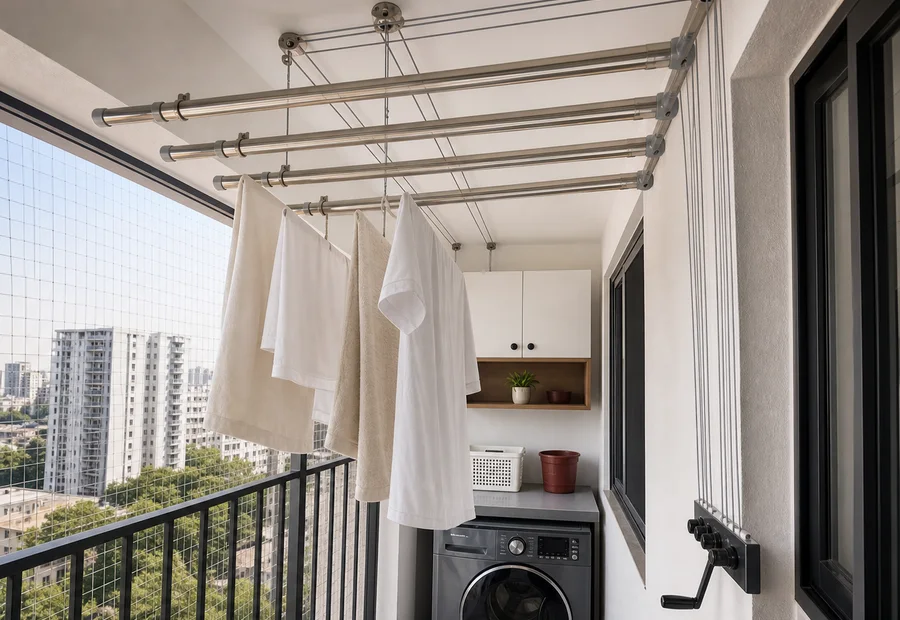
Most homes need a neat way to dry clothes without filling the balcony floor, blocking plants, or making the utility area hard to use.
Balcony and utility drying setup
A good cloth hanger setup should make daily drying easier without blocking movement, balcony use, utility access, or window airflow. The right choice depends on ceiling height, wall strength, available reach, family laundry load, and how the space is used every day.
Planned for balconies, utility areas, bathrooms, laundry corners, and compact apartment spaces
Designed around ceiling height, reach, drying load, pulley movement, wall surface, and daily access
Most requested for
Most homes need a neat way to dry clothes without filling the balcony floor, blocking plants, or making the utility area hard to use.
Popular choices
Ceiling-mounted and pulley cloth hangers suit many apartments, while foldable wall units work better when ceiling fixing is not ideal.
Base location
Nagamma Safety Nets serves Bangalore from Marathahalli, with cloth hanger work planned around apartment, villa, and rental-home conditions.
Site fit
Cloth Hangers work looks simple from far away, but the lasting result depends on small site details. The right work starts by reading the balcony, window, or utility opening before choosing a fitting method.
Many Bangalore apartments have compact utility areas with washing machines, gas lines, pipes, windows, and cabinets. A cloth hanger should be placed so it does not block daily movement or appliance access.
A hanger that is too high is hard to use, while one that hangs too low interrupts the balcony. Pulley systems and rod placement should be planned based on actual reach.
Concrete ceilings, false ceilings, tiled walls, and balcony beams all need different fixing methods. The installer should check the surface before recommending a model.
For rental flats, it is better to confirm owner approval and choose a fitting style that avoids unnecessary damage. Some spaces may suit wall-mounted or removable options better.
Installation views
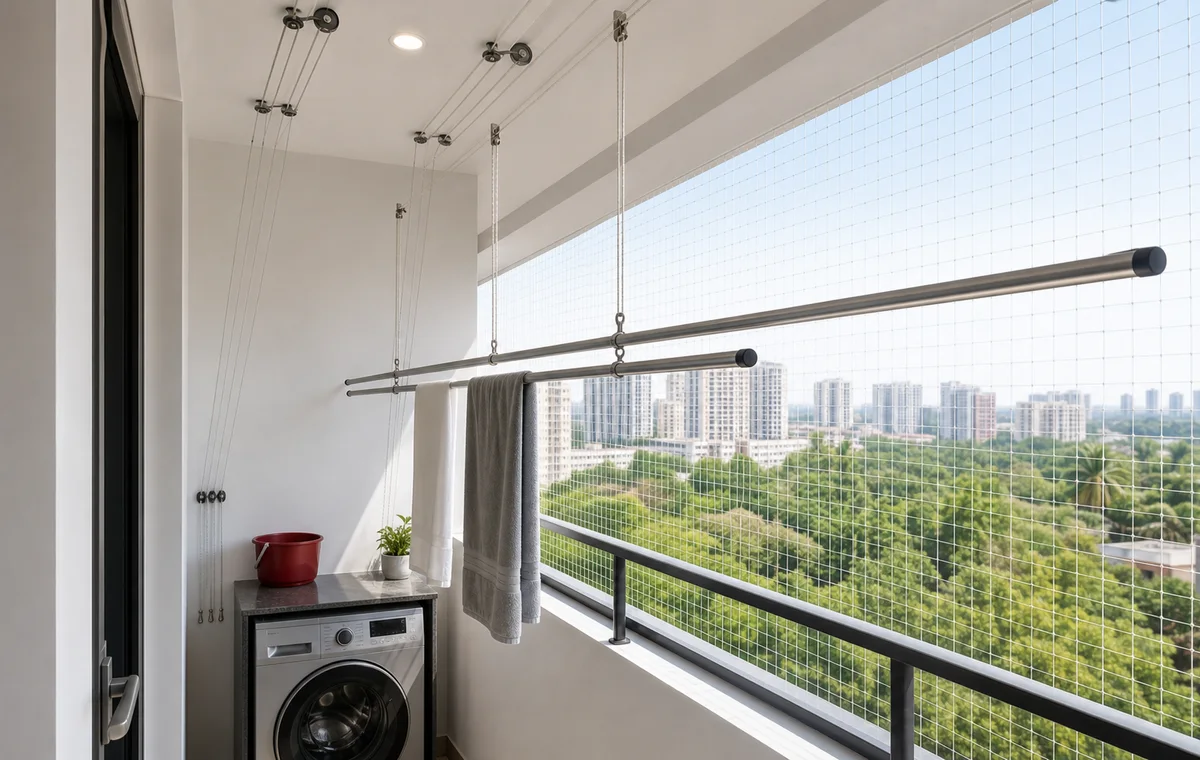
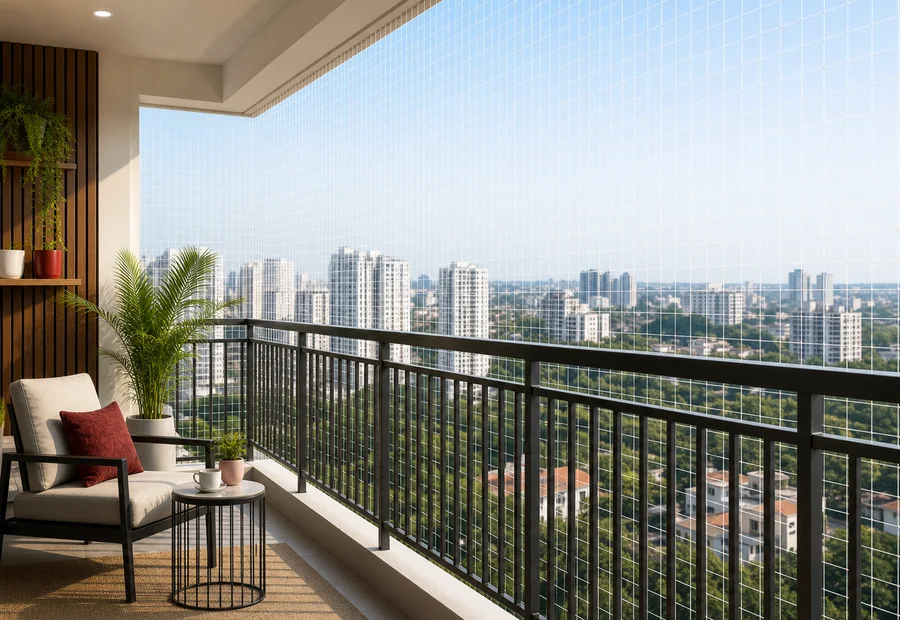
These views show the kind of balcony faces, window openings, and utility areas that need measured installation instead of a quick one-size-fits-all setup.
Materials
The net is only one part of the job. A reliable installation also needs the correct mesh size, edge support, fixing points, and a finish that works with the balcony surface.
| Part | Ask this | Good choice | Why it matters |
|---|---|---|---|
| Rod material | Is the rod stainless steel, aluminium, powder-coated, or plastic-coated? | Stainless steel or good-quality coated rods for regular wet-cloth use | Wet clothes add weight and moisture, so weak or poor-finish rods may bend, stain, or rust sooner. |
| Pulley and rope | Are the pulley wheels smooth and is the rope easy to replace later? | Smooth pulley movement with durable rope and accessible replacement path | A pulley hanger becomes irritating if it jams, slips, or needs too much effort every day. |
| Brackets and anchors | Will the brackets suit the ceiling or wall surface? | Strong anchors, screws, and brackets chosen after checking concrete, tile, or beam condition | The load is carried by fixing points, so weak anchors can loosen even if the hanger rods are good. |
| Load capacity | How much wet laundry can the hanger safely carry? | Capacity chosen for family size, washing frequency, and cloth type | Jeans, bedsheets, towels, and wet cotton loads need more strength than light daily clothes. |
| Finish and placement | Will it avoid lights, fans, windows, cabinets, and walking paths? | Measured placement that keeps drying practical and space usable | Even a good hanger feels wrong if it blocks a window, door, cabinet, or washing machine lid. |
Ask this
Is the rod stainless steel, aluminium, powder-coated, or plastic-coated?
Good choice
Stainless steel or good-quality coated rods for regular wet-cloth use
Why it matters
Wet clothes add weight and moisture, so weak or poor-finish rods may bend, stain, or rust sooner.
Ask this
Are the pulley wheels smooth and is the rope easy to replace later?
Good choice
Smooth pulley movement with durable rope and accessible replacement path
Why it matters
A pulley hanger becomes irritating if it jams, slips, or needs too much effort every day.
Ask this
Will the brackets suit the ceiling or wall surface?
Good choice
Strong anchors, screws, and brackets chosen after checking concrete, tile, or beam condition
Why it matters
The load is carried by fixing points, so weak anchors can loosen even if the hanger rods are good.
Ask this
How much wet laundry can the hanger safely carry?
Good choice
Capacity chosen for family size, washing frequency, and cloth type
Why it matters
Jeans, bedsheets, towels, and wet cotton loads need more strength than light daily clothes.
Ask this
Will it avoid lights, fans, windows, cabinets, and walking paths?
Good choice
Measured placement that keeps drying practical and space usable
Why it matters
Even a good hanger feels wrong if it blocks a window, door, cabinet, or washing machine lid.
Compare
Cloth Hangers can be the right answer for many homes, but it is not the right answer for every balcony or window problem. This comparison keeps the decision honest.
| Option | Best for | Strength | Limitation | Choose when |
|---|---|---|---|---|
| Ceiling cloth hanger | Utility areas and balconies where floor space must stay clear | Uses overhead space and keeps drying rods out of the way when planned well | Needs a suitable ceiling or beam for secure fixing | You have ceiling height and want a neat permanent drying setup. |
| Pulley cloth hanger | Homes where rods need to come down for easy loading and go up for drying | Comfortable to use and practical for families with regular laundry | Pulley and rope quality matter, and poor systems can jam over time | Reach is a concern or the ceiling is high enough for an up-down system. |
| Wall-mounted foldable hanger | Rental homes, small balconies, bathrooms, and side walls | Compact, simple, and can fold away when not used | Carries less load than larger ceiling systems | You need a smaller drying option and ceiling drilling is not preferred. |
| Floor drying stand | Temporary drying and homes that do not want drilling | Portable and easy to move | Consumes floor space and can clutter compact balconies | The laundry load is light and permanent installation is not allowed. |
| Outdoor clothesline | Open terraces, villas, and spaces with strong side fixing | simple setup and simple for large clothes | Less neat for apartments and depends heavily on weather and fixing points | You have open outdoor space and do not need a polished balcony finish. |
Best for
Utility areas and balconies where floor space must stay clear
Strength
Uses overhead space and keeps drying rods out of the way when planned well
Limitation
Needs a suitable ceiling or beam for secure fixing
Choose when
You have ceiling height and want a neat permanent drying setup.
Best for
Homes where rods need to come down for easy loading and go up for drying
Strength
Comfortable to use and practical for families with regular laundry
Limitation
Pulley and rope quality matter, and poor systems can jam over time
Choose when
Reach is a concern or the ceiling is high enough for an up-down system.
Best for
Rental homes, small balconies, bathrooms, and side walls
Strength
Compact, simple, and can fold away when not used
Limitation
Carries less load than larger ceiling systems
Choose when
You need a smaller drying option and ceiling drilling is not preferred.
Best for
Temporary drying and homes that do not want drilling
Strength
Portable and easy to move
Limitation
Consumes floor space and can clutter compact balconies
Choose when
The laundry load is light and permanent installation is not allowed.
Best for
Open terraces, villas, and spaces with strong side fixing
Strength
simple setup and simple for large clothes
Limitation
Less neat for apartments and depends heavily on weather and fixing points
Choose when
You have open outdoor space and do not need a polished balcony finish.
Process
Good cloth hangers work should feel measured and calm. The installer has to understand the opening, fixing points, safety expectation, and how the space will be used after the job.
The first step is to understand family size, washing frequency, heavy clothes, available drying time, and whether the space is a balcony, utility area, bathroom, or laundry corner.
The installer should check ceiling strength, beam location, tile surface, window opening, washing machine lid, lights, fans, and the walking path before marking points.
Ceiling, pulley, foldable, or wall-mounted options are chosen based on reach, load, space, rental rules, and how visible the setup will be.
Brackets and anchors are fixed with measured alignment so rods stay level and pulley movement remains smooth. Tile and ceiling drilling need extra care.
After installation, the hanger should be tested for movement, rod balance, rope path, and basic load. The customer should know what not to overload and how to clean or replace rope later.
Measure the utility or balcony space and note washing machine, window, pipe, fan, and cabinet positions.
Check if the ceiling is concrete, false ceiling, beam, or tiled surface before booking.
Choose pulley systems when reach is difficult or ceiling height is high.
Choose foldable wall units when ceiling drilling is not possible or the home is rented.
Avoid placing rods where wet clothes block doors, windows, lights, or appliance access.
Ask how rope, pulley wheels, or rods can be serviced or replaced later.
Do not overload rods with too many wet jeans, towels, or bedsheets at one time.
Wipe rods regularly so moisture and detergent residue do not build up.
Check screws, brackets, and rope after a few weeks of use and after heavy loading.
Do not pull pulley ropes sharply; smooth use keeps the system working longer.
Areas
Start with the nearest area page. Marathahalli is the business base, and the same service route is available across Bangalore.
Open page
Open page
Open page
Open page
Open page
Open page
Open page
Open page
Open page
Open page
Open page
Open page
Open page
Open page
Open page
GMB location
Open page
Open page
Open page
Open page
Open page
FAQ
These answers are written for real buying decisions: material, drilling, airflow, children, pets, and future repair work.
For many apartments, ceiling or pulley cloth hangers work well in utility areas because they keep the floor clear. Foldable wall units are better when ceiling drilling is not possible or the drying load is smaller.
Yes. Utility areas are one of the best places for cloth hangers when the setup avoids washing machine lids, pipes, gas lines, windows, and daily walking space.
Sometimes a wall-mounted or foldable hanger can be used instead of ceiling drilling. For ceiling and pulley systems, secure drilling is usually needed unless an existing support point is available.
A good pulley hanger should lower smoothly for loading clothes and lift without too much effort. Pulley wheel quality, rope path, and rod balance decide how comfortable it feels.
Good stainless steel or coated rods resist rust better, but quality matters. Wet clothes, detergent residue, and poor ventilation can affect cheaper rods faster.
Load capacity depends on rod material, bracket strength, anchor quality, and ceiling condition. Heavy wet clothes like towels, jeans, and bedsheets should be spread across rods instead of overloaded in one place.
Cloth hanger visits are planned from Marathahalli toward Whitefield, Bellandur, KR Puram, HSR Layout, Sarjapura, Electronic City, JP Nagar, Yelahanka, Kengeri, Thanisandra, and nearby homes where ceiling strength, utility width, and washing-machine clearance need checking.
Search the service with your Bangalore area to open the correct matching page path.
Marathahalli, Bangalore
Share the service, area, and a few photos of the opening. The visit can be planned around the surface, access, material, and daily use of the space.